
Learning the machine learning interview questions are essential to ace ML interviews and land your dream job. By learning these questions and their answers, you can crack different technical rounds of FAANG+ companies.
Machine learning (ML) entails resolving real-world issues. Machine learning algorithms learn from data instead of using a hard coding rule to solve a problem. Around 82% of the companies are using Machine learning and AI to get the most out of their investments. As a result, the need for expert machine learners has skyrocketed.
Having trained over 10,000 software engineers, we know what it takes to crack the toughest tech interviews. Our alums consistently land offers from FAANG+ companies. The highest ever offer received by an IK alum is a whopping $1.267 Million!
At IK, you get the unique opportunity to learn from expert instructors who are hiring managers and tech leads at Google, Facebook, Apple, and other top Silicon Valley tech companies.
In this article, we will discuss some tips to help you prepare for an ML interview. Further, we discuss several machine learning interview questions on the basis of programming skills, algorithms & theory, and general interest. We also provide some practice machine learning interview questions.

If you are looking for how to prepare for ML interviews, you must grasp in-depth knowledge about the subject. Machine learning engineer interview questions are asked in the following four aspects:
You should prepare from books at the initial stages. You must know the fundamentals of machine learning, its terminologies, and its scope to represent yourself as the right fit in your machine learning system design interview.
You should mention experiences briefly concerning machine learning. Technical companies look for experienced and knowledgeable machine learning engineers. You should read the job description carefully and prepare a list of key roles they are looking for. If they are looking for a system design machine learning engineer, you can expect behavioral and situational questions in your interview.
Additionally, to crack any interview in the first attempt, you must prepare machine learning engineer interview questions and learn how to answer them professionally. Below are 50+ machine learning interview questions that you can practice to let your interviewer know you are the right person for their company.
Also read: Machine Learning vs. Data Science — Which Has a Better Future?
You must rehearse machine learning engineer interview questions beforehand. You must practice them in speech and learn how to answer them professionally. Here are a few machine learning engineer interview questions based on programming skills, algorithms, and companies.
You can answer this machine learning interview question by stating that corrupted or missing data in a dataset can be found by either dropping those rows or columns or replacing them with another value. There are two methods – isnull() and dropna(). These methods will help you find columns of missing/corrupted data. If you want to fill invalid values with a placeholder value, you could use the fillna() method.
This is one of the commonly asked machine learning interview questions that test your knowledge and experience in Spark. It is a great tool used to handle massive datasets with speed. It is presently in demand. So, you must have sufficient knowledge and experience using it if you want to nail your machine learning interview.
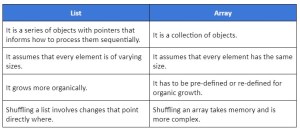
The differences between a list and an array are:
A hash table is a data structure that produces an associative array. A hash table is used for database indexing. In a hash table, a key is mapped to certain values through a hash function.
If you are attempting machine learning interview questions at top-ranked technical or FAANG companies, you must have a profound knowledge of various data formats. SQL is one of those. You should be familiar with how to manipulate SQL databases. The key differences between a primary and foreign key are:

You must be adept in JSON to answer these types of machine learning interview questions. You can say that JSO supports six data types – numbers, strings, objects, null values, arrays, and booleans.
Learn some tips on Google Machine Learning Engineer Interview Prep here.
The following are some of the commonly asked machine learning interview questions on algorithms & theory:
Bias is an error that occurs due to overly simplistic assumptions or erroneous assumptions in the learning algorithm. If you use bias, it can lead to the model underfitting your data with low predictive accuracy.
On the other hand, variance is an error due to the complexity of the learning algorithm. In variance, your data gets highly sensitive to high degrees of variation, leading your model to overfit the data. You’ll end up carrying noise from your training data for your model to be useful for your test data.
In answering this machine learning interview question, you can say that supervised learning requires training the labeled data. For instance, to classify a supervised learning task, you must first label the data you’ll use to train the model. Contrastingly, unsupervised learning does not require labeling data explicitly.
ROC is a graphical representation of the contrast between true positive rates and false positive rate at various thresholds. You should know that it’s often used as a proxy for the trade-off between the true positives (sensitivity of the model) vs. the false positives (fall-out or probability to trigger a false alarm).
To answer machine learning interview questions based on Bayes’ theorem, your concepts of mathematical topics must be clear. Using Bayes’ theorem, you can get the posterior probability of an event given that is known as prior knowledge. Bayes’ theorem notably includes the Naive Bayes classifier.
To answer this machine learning interview question, you can say that Naive Bayes is considered naive because it makes assumptions impossible to see in real-life data. Despite its practical applications, especially in text mining, the resulting probability implies the absolute independence of features, which is a condition that can never be met in real life.
To answer this machine learning interview question, you can say that L1 is binary/sparse, with many variables assigned a 1 or 0 in weighting. It corresponds to setting a Laplacean before the terms. In contrast, L2 regularization tends to spread error among all the terms. L2 corresponds to a Gaussian prior.
You must be well-versed in deep learning to answer these types of machine learning interview questions. Deep learning is a subset of machine learning. It is concerned with neural networks to perform the following operations:
It represents an unsupervised learning algorithm that learns data representations through the use of neural networks.
The following machine learning interview questions are related to general interest in the topic.
You must know that various top technical and FAANG companies look for experienced machine learning engineers. So, while answering these types of machine learning interview questions, you must highlight your experiences to make a difference in your hiring process. You can tell them about the research papers co-authored or supervised by leaders in the field.
These types of questions are asked to test your deep knowledge about machine learning in an interview. Make sure to have a few examples in mind and describe what resonated with you. You must demonstrate an interest in how machine learning is implemented.
These are the most asked machine learning interview questions. You should be passionate about machine learning to answer such questions. Answering these questions will strongly impact the interviewer at any FAANG or top technology company. You must have adequate knowledge about datasets and which one is great.
You need to have clear concepts of APIs to answer these types of machine learning interview questions. If you have worked with external data sources, it will be easier to answer these questions. You can mention the kinds of experiments and pipelines you have run in the past. You can also mention how APIs’ usage has transformed over the past years.
These types of machine learning interview questions test your interest in quantum computing. You must answer these questions concerning the present-day scenarios and how this new format and way of thinking will change the future. You must demonstrate your knowledge in this area to show your keen interest in machine learning at a higher level.
Here are a few sample machine learning interview questions for your practice:
Also read: Amazon Machine Learning Engineer Interview Process
If you need help with your prep, join Interview Kickstart’s Machine Learning Interview Masterclass — the first-of-its-kind, domain-specific tech interview prep program designed and taught by FAANG+ instructors.
IK is the gold standard in tech interview prep. Our programs include a comprehensive curriculum, unmatched teaching methods, FAANG+ instructors, and career coaching to help you nail your next tech interview.
Q1. How do I Prepare for Machine Learning Interview Questions?
To prepare for a machine learning system design interview, you must practice questions based on your skills in computer science fundamentals, machine learning algorithms, applications of these algorithms, and other related topics. You must also be adept in deep learning software engineering and answer questions related to compression, quantization, finance, hardware, and others.
Q2. Are Machine Learning Interview Questions Easy?
Machine Learning interview questions vary from company to company and the type of job profile. However, they are easy to answer if you know about the basics of machine learning. So, to ace your machine learning interview, you must acquire vast knowledge about the subject and its advantages/disadvantages.
Q3. What do Machine Learning Interview Questions Look Like?
If you are preparing for a machine learning interview, you can expect technical coding and questions like encoding a tweet or going through a log of processes. The technical part is to test your intuition for machine learning theory. Besides this, you can expect situational questions as a part of Machine Learning interview questions.
Related reads:


Time Zone:


Time Zone:


Time Zone:

Time Zone: Asia/Kolkata
Hands-on AI/ML learning + interview prep to help you win
Time Zone: Asia/Kolkata
Hands-on AI/ML learning + interview prep to help you win
Explore your personalized path to AI/ML/Gen AI success


